Introduction
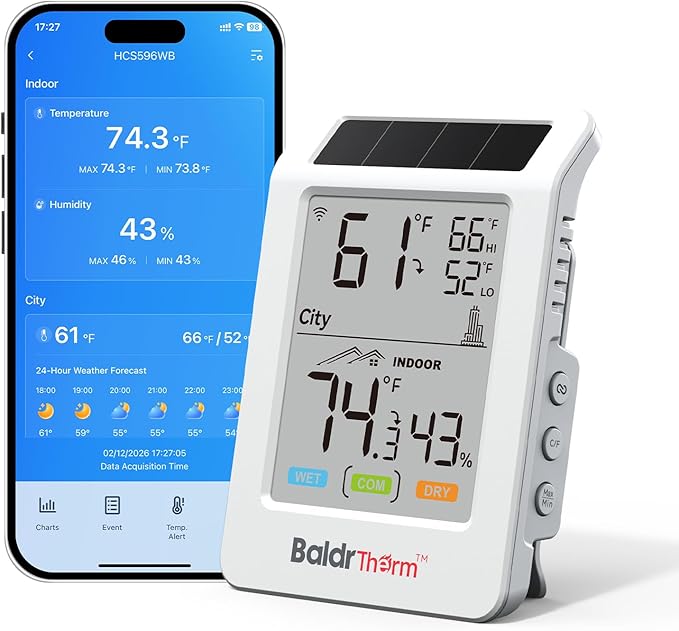
When I first came across the BaldrTherm Wireless Solar WiFi Thermometer and Hygrometer, I couldn't help but wonder if such a multi-functional device could live up to its promises. My initial skepticism was rooted in past experiences with over-hyped gadgets that offered more frustration than functionality. The idea of having a device that can monitor temperature and humidity wirelessly, powered by solar and battery, sounded almost too good to be true. However, given the increasing demands for smart home solutions—especially for environments that are sensitive to temperature and humidity like greenhouses and cellars—I decided to give it a try.
Pros & Cons
- Pros:
- Reliable remote monitoring with customizable alerts
- Large, easy-to-read 3.9" LCD display
- Solar-powered with an impressive 1-year battery life
- Versatile use cases for homes, greenhouses, and cellars
-
Accurate temperature and humidity readings
-
Cons:
- Requires a stable 2.4GHz WiFi connection, which isn't always feasible in remote areas
- Initial app setup can be slightly cumbersome
- Limited to indoor use unless well-protected from the elements
- Price point may be higher than simpler devices
- The device may not be intuitive for tech novices
Comparison
When compared to other models in the market, such as the ThermoPro TP65 and the Govee H5051, the BaldrTherm offers a unique combination of solar power and WiFi connectivity. While the ThermoPro excels with its intuitive user interface and robustness in outdoor conditions, it lacks the convenience of app-based remote monitoring. On the other hand, the Govee model provides app alerts but does not support solar power, making it less eco-friendly. BaldrTherm's solar-hybrid power system stands out in a niche of its own.
User Tips / Usage Guide
- Install in the Right Location: Ensure that the solar panel receives adequate light for optimal performance.
- Stable WiFi Connection: Make use of a strong 2.4GHz WiFi signal for consistent monitoring.
- Utilize the App Features: Customize alert thresholds for temperature and humidity to suit your environment.
- Check Battery Status Regularly: Though it boasts a year-long battery life, it's wise to check battery health periodically via the app.
- Regular Cleaning: Keep the solar panels clean from dust and debris for uninterrupted power supply.
- Calibrate Occasionally: Check calibration if readings differ massively from expected conditions.
- Secure Mounting: If wall-mounted, ensure the device is securely placed to avoid accidental dislodging.
- Familiarize with the Manual: Use the provided manual to expedite setup and troubleshoot common issues.
Conclusion
Against my expectations, the BaldrTherm Wireless Solar WiFi Thermometer and Hygrometer managed to win me over with its solid performance. It is a compelling option for anyone needing stress-free environmental monitoring, especially if your focus is on reducing carbon footprint with solar energy. Ideal for households that require precise, reliable readings in specific areas prone to temperature changes, this device is particularly beneficial for tech-savvy users looking for modern solutions. However, if you operate in regions with inconsistent WiFi or struggle with app-based interfaces, you might want to look at more conventional options. Overall, the BaldrTherm is a commendable addition to any smart home ecosystem.